
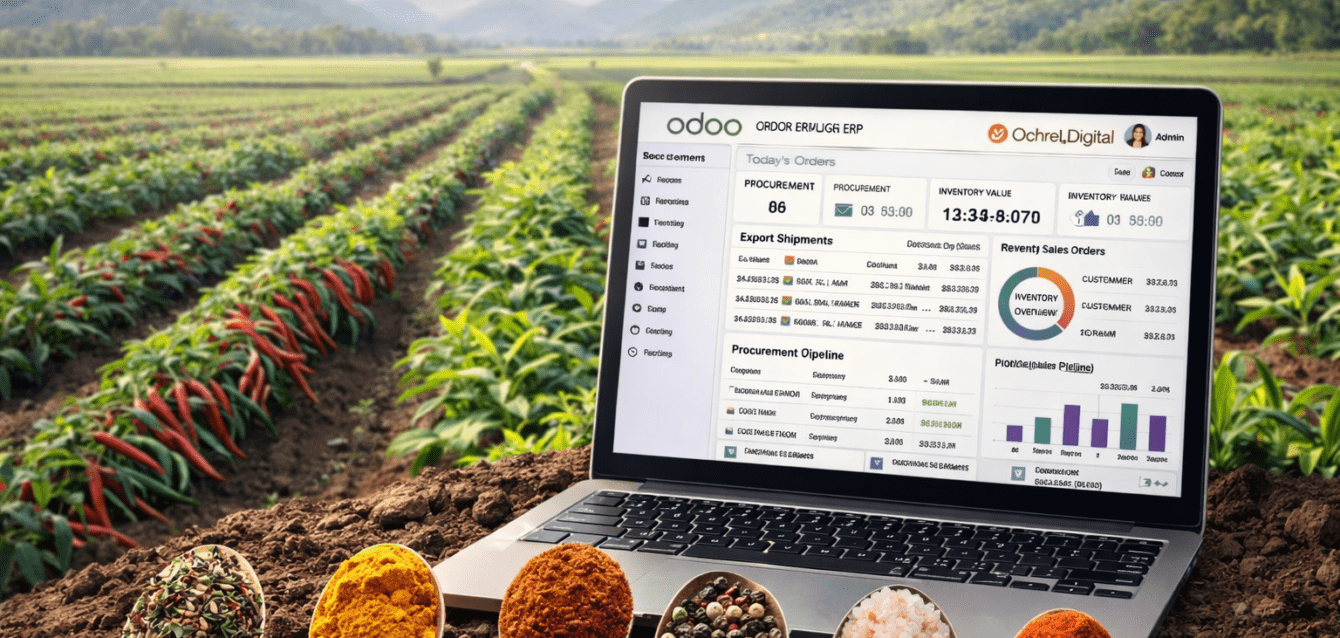
The global spice trade is no longer just about sourcing and selling. Today, it demands traceability, compliance, export documentation accuracy, quality control discipline, and real-time financial visibility.
Companies trading in organic spices, botanical herbs, agro commodities, and fresh produce operate in an increasingly regulated and competitive environment. Moreover, buyers expect transparency, batch-level traceability, and timely delivery without compromise.
However, many spice trading businesses still rely on fragmented systems, separate accounting software, manual stock registers, Excel-based procurement tracking, and disconnected export documentation processes.
As a result, operational complexity increases while visibility decreases.
To scale sustainably in domestic and global markets, spice traders need more than digitization. They need integration.
Odoo ERP provides that unified digital backbone. In India, Odoo ERP is fast spreading due to its flexible and comprehensive app suite tailored to the needs of mid to large spice players.
Odoo Summary: Measurable Business Benefits for Spice Industry Players
When properly implemented, Odoo enables spice trading companies to achieve:
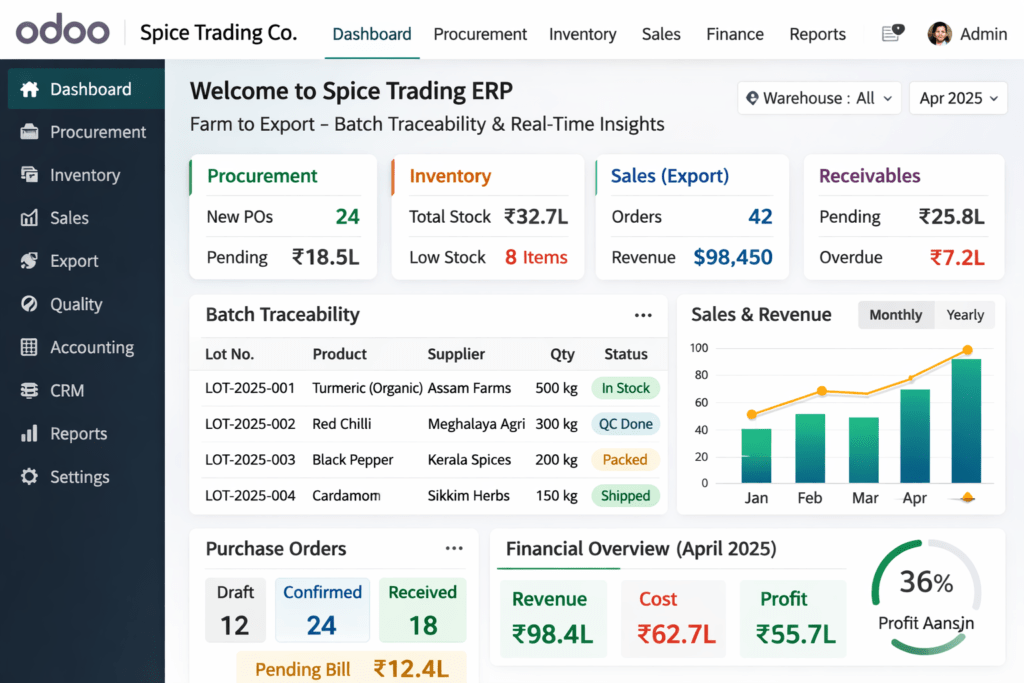
- End-to-end batch traceability
- Controlled procurement processes
- Real-time inventory visibility
- Accurate export documentation
- Stronger financial governance
- Improved working capital efficiency
- Data-driven sales strategy
Most importantly, the organization becomes scalable. People learn Odoo from early days and new people gets absorbed into this system seamlessly as companies grow. The data is built over the years to give you better data analytics for future-proof decision making over multiple years.
The Operational Challenges in Spice Trading
Before discussing solutions, let us examine the real friction points that limit growth in the spice industry.
1. Lack of Batch-Level Traceability
Spice businesses deal with:
- Multiple farmers
- Different harvest lots
- Varying moisture levels
- Quality grades
- Organic certifications
Without structured lot tracking, it becomes difficult to answer:
- Which farmer supplied this batch?
- What quality test report is linked to this shipment?
- Which export invoice corresponds to which lot?
This lack of traceability increases compliance risk, especially in export markets.
How Odoo Solves It
With Odoo Inventory and Lot/Serial Tracking:
- Every procurement batch is recorded with unique lot numbers
- Quality parameters can be attached to specific lots
- Vendor details are linked directly to the inventory batch
- Outgoing shipments trace back to exact source lots
Consequently, if a buyer raises a quality concern, the system identifies the exact supplier batch within seconds.
For exporters, this strengthens credibility.
For compliance teams, it ensures audit readiness.
2. Disconnected Procurement and Supplier Management
Spice traders often source from multiple farmer networks and aggregators. However, when procurement runs through emails, phone calls, and spreadsheets, price comparison and vendor performance tracking become inconsistent.
Over time, this leads to:
- Margin fluctuations
- Delayed payments
- Vendor disputes
- Supply chain inefficiencies
How Odoo Solves It
Through Odoo Purchase module:
- Purchase orders are created systematically
- Vendor price lists are stored centrally
- Historical procurement rates are trackable
- Delivery timelines are monitored
- Vendor bills link directly to purchase orders
Moreover, supplier performance reports provide insight into reliability and pricing consistency.
As a result, procurement becomes strategic rather than reactive.
3. Inventory Valuation and Stock Visibility Issues
Spice trading businesses manage:
- Raw unprocessed spices
- Cleaned and graded stock
- Packed finished goods
- Export-ready consignments
Without centralized inventory management, businesses face:
- Stock mismatches
- Incorrect valuation
- Expiry or quality degradation risks
- Cash flow blockages
How Odoo Solves It
Odoo Inventory enables:
- Multi-warehouse management
- Real-time stock movement tracking
- FIFO or weighted average valuation
- Quality check integration
- Repackaging and internal transfers
Finance teams gain accurate inventory valuation instantly. Meanwhile, operations can track which stock is aging and requires immediate dispatch.
Consequently, working capital management improves significantly.
4. Complex Export Documentation and Compliance
Exporting spices involves:
- Commercial invoices
- Packing lists
- Phytosanitary certificates
- Certificate of origin
- Organic certifications
- HS code classification
Manual document preparation increases risk of mismatch between shipment and invoice.
How Odoo Solves It
Odoo Sales and Accounting integration ensures:
- Export invoices auto-generate from confirmed sales orders
- Packing lists align with actual lot dispatch
- HS codes and product classifications remain standardized
- Currency conversions update automatically
Furthermore, export-specific tax settings simplify compliance across markets.
As a result, documentation errors reduce and shipment delays minimize.
5. Financial Control and Cash Flow Management
Spice trading often involves:
- Advance payments
- Letter of credit transactions
- Multi-currency receivables
- Freight and logistics costs
Disconnected accounting systems limit financial visibility.
How Odoo Solves It
Odoo Accounting provides:
- Multi-currency transaction management
- Bank reconciliation automation
- Receivables aging reports
- Profitability analysis per shipment
- Cost allocation for logistics and freight
Therefore, management gains clear insight into margins at product, customer, and shipment level.
This transforms finance from bookkeeping to strategic oversight.
6. Limited Sales and Customer Intelligence
Spice traders serve B2B buyers such as:
- Food manufacturers
- Pharmaceutical companies
- Export distributors
- Retail chains
However, when CRM and sales operate separately from accounting, growth opportunities remain hidden.
How Odoo Solves It
With Odoo CRM and Sales:
- Buyer inquiries are tracked systematically
- Follow-ups are scheduled
- Quotation conversion rates are measured
- Repeat purchase patterns are analyzed
Additionally, pricing can be customized per client segment.
Consequently, sales forecasting becomes reliable and structured.
Digital Integration Across the Spice Supply Chain
The true strength of Odoo lies in integration.
When procurement, inventory, sales, and accounting operate within one platform:
- Purchase cost flows into inventory valuation
- Inventory movement triggers financial updates
- Sales invoices reflect exact lot dispatch
- Payment tracking updates receivable status
This eliminates duplicate data entry and reconciliation gaps.
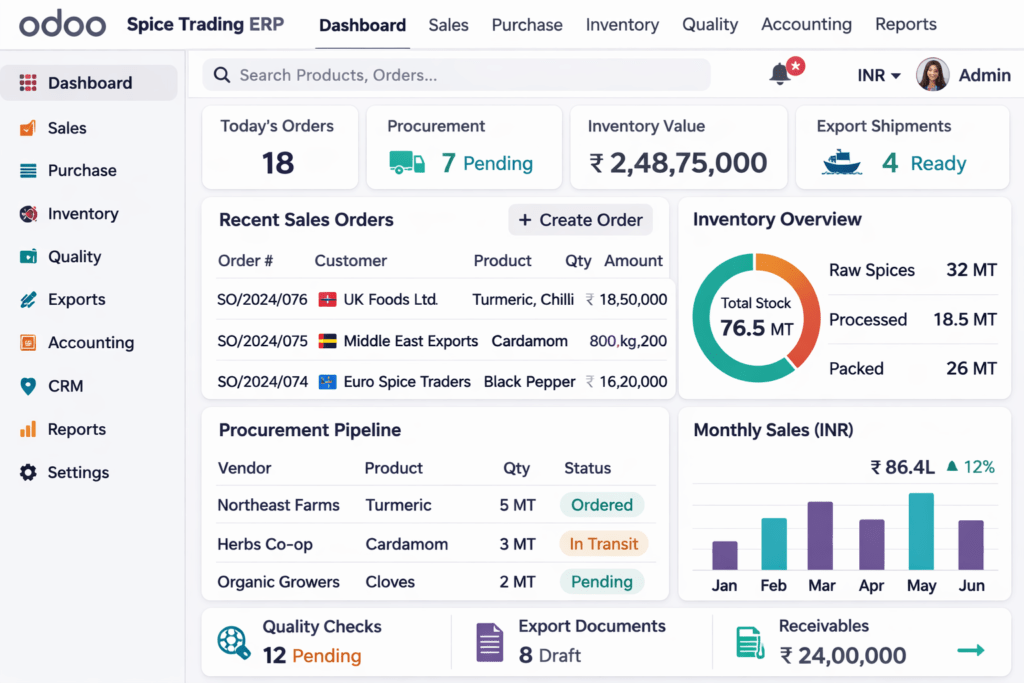
Moreover, management dashboards provide:
- Revenue breakdown by product
- Margin by customer
- Vendor performance metrics
- Stock turnover ratios
- Export vs domestic sales split
Thus, leadership makes decisions based on real-time data.
Conclusion: Building a Future-Ready Spice Trading Enterprise
The spice industry is deeply rooted in tradition. However, global trade demands modern operational discipline.

Transparency, traceability, compliance, and financial clarity are no longer optional, they are competitive advantages.
Odoo ERP provides a structured digital framework that connects farmers, warehouses, finance teams, export departments, and sales operations into a single ecosystem.
For procurement teams, it ensures supplier accountability.
For finance leaders, it delivers financial transparency.
For export managers, it guarantees documentation accuracy.
For management, it provides strategic control.
In a market where quality and trust define long-term success, operational integration becomes the true differentiator.