
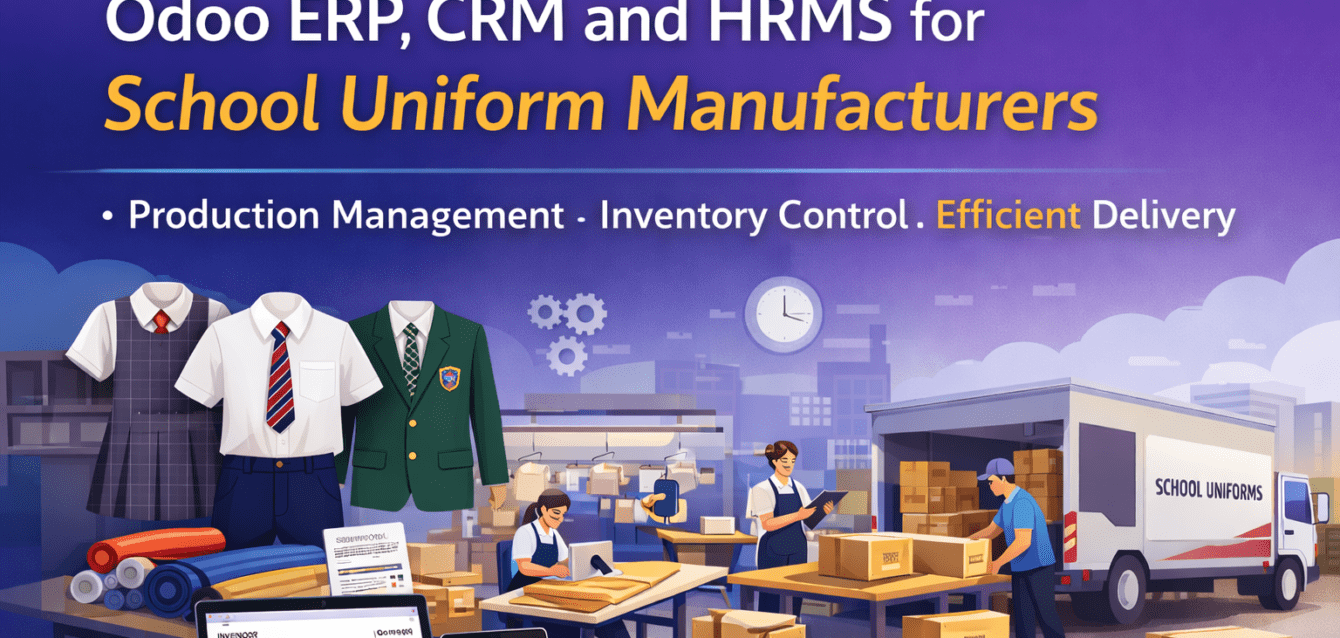
School uniform manufacturing is a specialized segment within the garment industry. Unlike fashion apparel manufacturing where designs change frequently and production cycles vary, uniform manufacturing revolves around large seasonal orders, strict delivery timelines, and complex size variations.
Every year, before the start of an academic session, manufacturers must deliver thousands of uniforms across multiple sizes and styles. These orders must be produced, packed, and shipped within a narrow timeframe. Any delay can affect schools, distributors, and retailers waiting to supply uniforms to students.
Despite the scale and complexity of these operations, many uniform manufacturers still rely on Excel spreadsheets, handwritten production registers, WhatsApp communication, and verbal updates between departments.
While this approach might work for smaller operations, it quickly becomes inefficient when production volume increases. Lack of visibility between departments can lead to delays, inventory mismatches, and operational confusion.
This is where modern ERP platforms like Odoo become valuable. Instead of managing sales, inventory, procurement, and production through disconnected systems, manufacturers can run the entire operation on a single integrated platform.
When properly implemented, ERP systems allow garment manufacturers to move from reactive operations to structured, predictable, and scalable production workflows.
This article explores how a uniform manufacturing company can use Odoo to streamline operations—from order management to production planning, inventory control, workforce tracking, and dispatch management.
Understanding the Operational Challenges of Uniform Manufacturing
Before discussing ERP implementation, it is important to understand the operational reality inside most uniform manufacturing facilities.
Unlike standard garment production, uniform manufacturing involves several unique complexities.
First, orders typically contain multiple size combinations. A single school order may include shirts or trousers ranging from size 22 to size 40, each with different quantities.
Second, demand is highly seasonal. The majority of production happens during the months leading up to the academic year, which means factories must operate at peak efficiency during this period.
Third, manufacturers must maintain strict control over fabric consumption and accessories, because margins can quickly erode if material usage is not tracked accurately.
Fourth, production involves several operational stages including:
- Fabric cutting
- Stitching
- Assembly
- Finishing
- Quality inspection
- Packing
Without a centralized system, supervisors must manually track the progress of each production batch.
Common issues in such environments include:
- Production supervisors chasing updates from workers
- Fabric shortages discovered only after cutting begins
- Confusion about which order is currently on the stitching line
- Delays caused by uneven workload distribution
- Dispatch errors due to manual packing records
An ERP system solves these issues by digitizing the entire production lifecycle.
Managing Uniform Orders with Structured Sales Workflows
The first step in any manufacturing operation is capturing customer orders accurately.
Uniform orders often arrive from schools, distributors, or wholesalers. These orders may include several garment types and hundreds of size combinations.
For example, a single order may include:
- School shirts in eight sizes
- Trousers in six sizes
- Skirts for girls in five sizes
- Different color combinations for primary and secondary sections
Manually managing these combinations in spreadsheets often leads to errors.
Inside Odoo, each uniform product can be configured with size variants. When a sales order is entered, the system records the exact quantity required for each size.
For example:
| Product | Size | Quantity |
|---|---|---|
| School Shirt | 26 | 150 |
| School Shirt | 28 | 200 |
| School Shirt | 30 | 250 |
| School Trousers | 28 | 180 |
Once the order is confirmed, the ERP system automatically communicates the demand to the production and inventory departments.
This eliminates the need for manual coordination between sales and manufacturing teams.
Creating Bills of Materials for Uniform Production
One of the most important components of garment manufacturing ERP is the Bill of Materials (BOM).
A BOM defines exactly how much material is required to produce one garment.
For example, producing a school shirt might require:
- 1.4 meters of fabric
- 7 buttons
- 1 collar fuse
- stitching thread
- label and tag
In Odoo, every garment product can have its own BOM configuration.
This allows the system to automatically calculate total material requirements when production begins.
For example, if an order requires 1000 shirts, the system can instantly determine:
- Total fabric required
- Total number of buttons needed
- Required accessories and trims
This removes guesswork from material planning and helps procurement teams prepare in advance.
Defining Work Centers for Factory Operations
Uniform manufacturing involves multiple operational stages that must happen in sequence.
Instead of managing these steps informally, ERP systems allow manufacturers to define Work Centers.
A work center represents a specific area or machine group where a production operation takes place.
Typical work centers in a garment manufacturing unit include:
- Fabric Cutting Section
- Collar Stitching Line
- Sleeve Assembly Line
- Main Stitching Line
- Buttoning Section
- Finishing and Ironing
- Packing Department
Each work center can be configured with its capacity, available workers, and expected processing time.
Within Odoo, work centers form the backbone of the production workflow.
When manufacturing orders are created, the system automatically routes them through the defined work centers in the correct sequence.
This ensures that production follows a structured path rather than relying on manual supervision.
Production Planning and Scheduling
Production scheduling is often the most challenging part of garment manufacturing.
Without proper planning tools, stitching lines may sit idle while cutting teams prepare materials, or vice versa.
Using the planning tools in Odoo, production managers can assign manufacturing orders to different work centers based on capacity.
The system provides a visual overview of workload distribution across the factory.
Managers can quickly answer operational questions such as:
- Which stitching line has available capacity tomorrow?
- Which order must be prioritized to meet dispatch deadlines?
- How many garments can be produced per shift?
Orders can be rescheduled easily if delays occur in earlier stages.
This level of planning helps factories maximize machine utilization while avoiding production bottlenecks.
Tracking Work-in-Progress Across the Factory
One of the biggest operational blind spots in garment manufacturing is work-in-progress tracking.
In many factories, supervisors must physically walk across the shop floor to understand the status of production.
This approach is inefficient and prone to miscommunication.
With ERP-driven manufacturing workflows, production progress is recorded digitally at every stage.
For example:
When cutting is completed, the system marks the operation as finished and moves the batch to the stitching stage.
Similarly, once stitching is completed, garments move to finishing.
Managers can view real-time dashboards showing:
- Units currently in cutting
- Units in stitching
- Units pending finishing
- Completed garments ready for packing
This transparency allows factory management to detect delays early and take corrective action.
Inventory Management for Fabric and Accessories
Fabric is typically the largest cost component in uniform manufacturing.
Without a structured inventory system, manufacturers often struggle with:
- Fabric shortages during peak production
- Excess stock occupying warehouse space
- Difficulty tracking dye lots and fabric rolls
With integrated inventory management in Odoo, manufacturers can track materials with greater accuracy.
The system records:
- Fabric rolls received from suppliers
- Batch or lot numbers
- Quantity available in stock
- Materials consumed in each production order
As manufacturing orders progress, the system automatically deducts raw materials based on the defined BOM.
Warehouse managers can also set minimum stock levels to trigger procurement alerts.
Procurement Planning for Manufacturing
Uniform manufacturers typically rely on multiple suppliers for materials such as fabric, buttons, zippers, labels, and packaging.
Manual procurement planning can lead to delays if materials are not ordered in time.
ERP systems connect procurement directly to production planning.
When material shortages are detected, the system automatically suggests purchase orders.
For example, if production requires 3000 buttons but only 1200 are available in inventory, the system recommends purchasing the remaining quantity.
This ensures production schedules are not disrupted due to missing materials.
Integrating Quality Control into Production
Quality consistency is critical for school uniforms because schools expect identical garments across batches.
Quality control checkpoints can be embedded within production workflows.
For instance, inspections may occur:
- After fabric cutting
- After stitching
- Before packing
Using Odoo, quality teams can record inspection results, flag defective pieces, and trigger corrective actions.
This ensures only approved garments move forward in the production process.
Streamlining Packing and Dispatch
The final stage of uniform manufacturing is packing and dispatch.
Uniform orders must typically be packed size-wise or school-wise.
For example:
- Shirt Size 28 – Bundle of 20 pieces
- Shirt Size 30 – Bundle of 20 pieces
ERP systems allow warehouse teams to pack products according to the original order structure.
Dispatch teams can generate:
- delivery challans
- packing lists
- shipment documentation
This reduces dispatch errors and ensures schools receive the correct uniform sizes.
Real-Time Business Visibility for Management
One of the biggest advantages of ERP implementation is visibility for business owners and senior management.
Instead of relying on verbal updates from supervisors, leadership teams can access live dashboards showing:
- production progress
- pending orders
- inventory levels
- procurement requirements
- worker productivity
This visibility helps management make faster decisions and respond quickly to operational challenges.
Business Benefits of ERP for Uniform Manufacturers
When uniform manufacturers adopt a unified ERP platform like Odoo, they typically experience improvements across multiple areas of the business.
Production planning becomes more accurate because orders are automatically translated into manufacturing requirements.
Inventory management improves because fabric and accessories are tracked systematically.
Communication between departments becomes easier because everyone works within the same system.
Dispatch timelines improve because production stages are monitored in real time.
Most importantly, business owners gain complete operational visibility, which enables them to scale production confidently.
The Future of Uniform Manufacturing is Digital
The garment manufacturing industry is evolving rapidly. Customers expect faster deliveries, better quality, and transparent communication.
Factories that continue to rely on disconnected tools and manual processes often struggle to maintain efficiency as order volumes grow.
Adopting an integrated ERP platform like Odoo allows manufacturers to modernize operations without losing control over production.
With the right ERP implementation, uniform manufacturers can shift from reactive problem solving to structured, scalable production management.
This transformation not only improves operational efficiency but also positions the business for long-term growth in an increasingly competitive market.
Frequently Asked Questions: ERP for School Uniform Manufacturers
What is the best ERP for school uniform manufacturers?
One of the most flexible ERP platforms for uniform manufacturing businesses is Odoo. It integrates sales orders, production planning, inventory management, procurement, and accounting into one system. This allows manufacturers to manage size variants, raw materials, production workflows, and dispatch operations from a single dashboard.
How does ERP help garment manufacturing companies?
ERP systems help garment manufacturers streamline operations by connecting production planning, inventory tracking, and procurement into a unified workflow. With Odoo, businesses can track raw materials, automate manufacturing orders, monitor work-in-progress, and ensure timely deliveries while reducing manual errors.
Can ERP manage size variations in uniform production?
Yes. Uniform manufacturers deal with multiple size combinations such as 24, 26, 28, 30, and 32. Odoo supports product variants, allowing each garment to be defined with multiple sizes and attributes. This ensures accurate production planning and inventory tracking for each size variant.
How does ERP help control fabric consumption?
Fabric is the most expensive component in garment manufacturing. ERP systems calculate material requirements using Bills of Materials (BOM). In Odoo, each uniform product has a defined fabric requirement, allowing the system to automatically calculate total material consumption for every production order.
How can ERP track production stages in garment factories?
Manufacturing ERP systems track each stage of production through defined work centers such as cutting, stitching, finishing, and packing. Using Odoo, managers can monitor real-time production progress and identify bottlenecks across the factory floor.
Can ERP automate purchase planning for raw materials?
Yes. ERP platforms analyze inventory levels and production demand to suggest purchase orders automatically. When stock levels fall below required quantities, Odoo generates procurement recommendations for materials such as fabric, thread, buttons, and labels.
How does ERP improve inventory accuracy for garment manufacturers?
ERP systems maintain real-time inventory records by tracking material receipts, consumption, and finished goods movement. With Odoo, warehouse managers can monitor stock levels, batch numbers, and material usage, ensuring accurate inventory control across manufacturing operations.
Can ERP track production efficiency and worker productivity?
Yes. Manufacturing ERP solutions track work orders and operations at each work center. Odoo provides insights into production time, output quantities, and worker productivity, helping management identify inefficiencies and optimize factory performance.
Is ERP useful for managing school uniform contracts?
School uniform manufacturing involves bulk contracts with strict delivery timelines. ERP systems help manufacturers manage these contracts by linking sales orders to production and inventory. With Odoo, companies can plan production based on confirmed orders and avoid excess inventory.
How does ERP improve delivery and dispatch management?
ERP systems organize finished goods according to order requirements and size combinations. Odoo allows warehouse teams to generate delivery orders, packing lists, and shipment documentation, ensuring accurate and timely dispatch to schools or distributors.
Is ERP suitable for small and mid-sized garment manufacturers?
Yes. Unlike traditional ERP systems that require heavy customization, Odoo is modular and scalable. Small and mid-sized garment manufacturers can start with core modules like inventory, manufacturing, and sales, then expand as their business grows.
What are the benefits of ERP implementation in garment manufacturing?
ERP implementation improves operational efficiency, reduces production delays, enhances inventory control, and provides real-time business visibility. With Odoo, garment manufacturers can scale operations while maintaining accuracy in production planning, procurement, and financial management.