
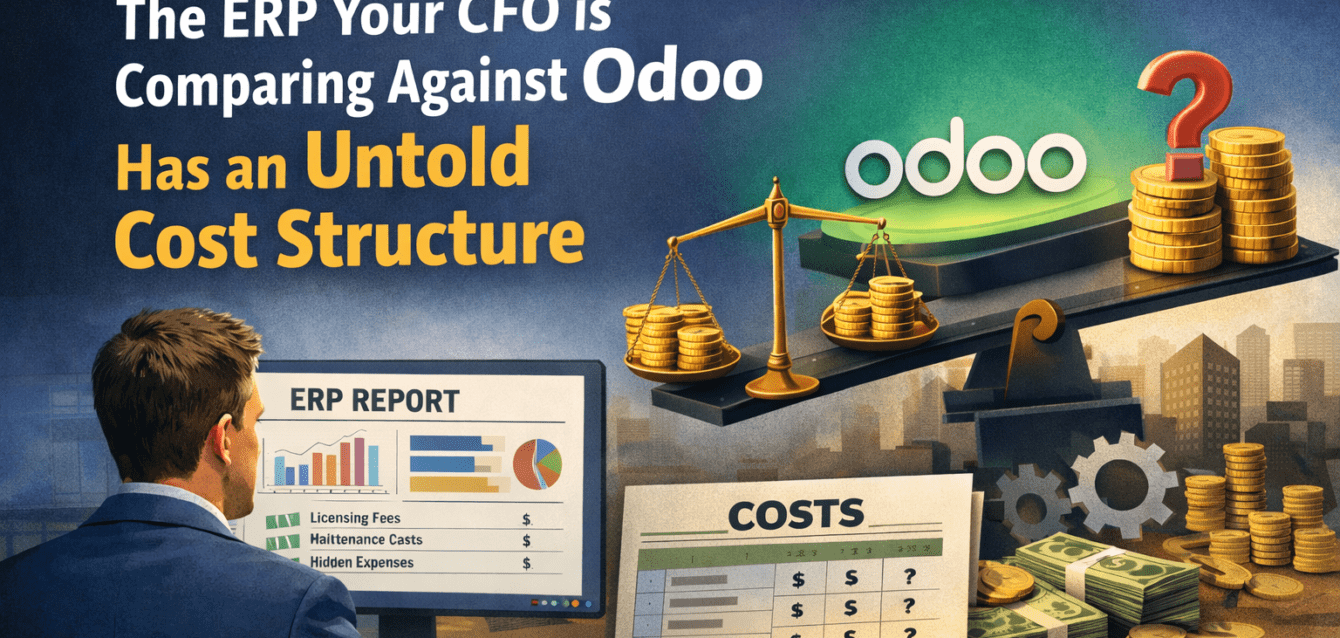
“We are evaluating two options. Odoo and SAP Business One.”
That sentence arrives in pre-sales calls more than any other. And it is a good problem to have. It means the business is serious about digital transformation, has a real budget, and has already done enough research to narrow the field to two credible platforms.
The difficulty is what comes next. Both vendors present their costs clearly. Both implementation partners present their proposals convincingly. And yet the number that shows up in the board approval three years later almost never matches either proposal.
This article is for the CFO, the operations head, or the founder who wants to understand what Odoo and SAP Business One actually cost over time in Indi, not what the brochure says, not what the partner’s opening proposal says, but what the business ends up paying across licensing, implementation, customisation, support, and the decisions that were made along the way.
Ochre.digital implements Odoo. We are not neutral. But we work in a market where SAP Business One is a real competitor, and our clients are better served by an honest comparison than a convenient one.
Strategic angle: Declaring the bias upfront (“we implement Odoo, not SAP B1”) is the single move that makes this article more trustworthy than every generic comparison that pretends to be neutral. Use it.
Section 1 – Why TCO comparisons are usually wrong
Why the Proposals You Receive Cannot Be Compared Directly
Set up the framework before the numbers. ERP steering committee that skips to numbers without this context makes bad decisions.
Explaining the three comparison errors Indian businesses consistently make:
- Comparing license cost only, not full deployment cost
- Comparing year-one cost, not 3-year or 5-year cost
- Comparing standard scope proposals when the actual scope is always different
Introducing the five TCO buckets that any honest comparison must cover: licensing, implementation, customisation, integrations, and ongoing support and upgrades. Every comparison that ignores any of these is incomplete by design.

Section 2 – Licensing cost comparison with real India numbers
Bucket 1: Licensing – What You Pay Before Anyone Does Anything
India-specific rupee numbers. This is the most-searched section and the one that gets featured snippets.
| Licence type | Odoo Enterprise | SAP Business One |
|---|---|---|
| Per user / year (cloud) | ~₹1,200–2,000/user/month | ~₹4,500–6,500/user/month (Professional) |
| Perpetual licence (on-prem) | Not available – subscription only | ₹1.37 lakh/user (Professional), ₹70K (Limited) |
| Annual maintenance (on-prem) | N/A | 18–22% of licence cost per year |
| 20-user, 3-year licence total | ~₹8–15 lakhs | ~₹28–45 lakhs (subscription) or ₹35–55 lakhs (perpetual + AMC) |
Cover the SAP B1 licence type complexity, Professional vs Limited vs Starter, and why most Indian businesses underestimate user count at the proposal stage and end up buying more licences post-go-live. Cover Odoo’s all-apps-included model and why it matters for businesses that expect to grow into new modules.
India note: SAP B1’s Limited licence (finance, logistics, or CRM only) is ₹70,840 per user per year perpetual. Even with top partner discounting, this cost is ₹40-50K per user per year perpetual. Businesses that start with Limited licences for most users frequently upgrade to Professional within 18 months, at full price. Budget for the upgrade, not the entry point.
Section 3 – Implementation cost comparison
Bucket 2: Implementation – Where Most of the Money Actually Goes
The number that varies most across proposals. Most Indian buyers compare the wrong thing here.
| Business profile | Odoo implementation | SAP B1 implementation |
|---|---|---|
| SME, 10–20 users, Finance + Inventory | ₹3–6 lakhs | ₹8–15 lakhs |
| Mid-market, 20–50 users, multi-dept | ₹8–15 lakhs | ₹18–35 lakhs |
| Manufacturing-heavy, 50+ users | ₹15–25 lakhs | ₹35–70 lakhs |
Explaining why SAP B1 implementation costs more: more rigid configuration methodology, higher consultant day rates (SAP-certified consultants in India command a premium), longer discovery-to-go-live timelines (3–9 months vs 6–16 weeks for Odoo), and more extensive testing requirements due to tighter module interdependencies.
Also suggesting what can make Odoo implementation costs approach SAP B1 costs: poorly scoped projects, over-customisation, multiple integrations, or choosing a partner that does not follow a structured methodology.
Section 4 – Customisation and add-on costs
Bucket 3: Customisation – The Cost Nobody Budgets for Accurately
SAP Business One’s customisation is done via the SAP Business One SDK and third-party ISV add-ons. Common Indian requirements, GST return filing, e-invoicing, industry-specific workflows, often require paid add-ons from SAP partners. These add ₹1–5 lakhs per add-on to the total, and most Indian SME deployments need 2–4 of them.
Odoo’s customisation is done directly in Python with Odoo’s own framework. No third-party add-on licence is required for most customisations. The cost is partner time, not software licence. For Indian compliance (GST, TDS, e-invoicing), Odoo’s Indian localisation module is included in the Enterprise subscription.
The most common hidden cost in SAP B1 India deployments: the Crystal Reports add-on for custom MIS reports, GST filing integration via third-party tools, and manufacturing-specific add-ons for shop floor or quality control. Each is a separate vendor relationship with its own annual cost.
Section 5 – Support and upgrade costs
Bucket 4: Annual Support and Upgrades – The Cost That Compounds
| Cost component | Odoo | SAP Business One |
|---|---|---|
| Annual support / AMC | Included in subscription or 15–20% of impl. cost | 18–22% of perpetual licence cost per year |
| Version upgrades | Included in subscription (annual Odoo versions) | Separate project cost per major upgrade |
| Consultant availability India | Wide – 500+ Odoo partners in India | Narrower – fewer certified SAP B1 partners |
The compounding cost problem: SAP B1’s AMC runs 18–22% of licence cost every year. On a 20-user perpetual licence deployment (₹35–40 lakhs initial), that is ₹6–9 lakhs per year just for maintenance – before any new development or upgrades. Over 5 years, the AMC alone can exceed the original implementation cost.
Odoo’s upgrade model: annual major releases, upgrade cost depends on the amount of custom code. Partners with clean implementations (minimal customisation, configure-first discipline) can upgrade clients in 2–4 weeks. Partners with heavy custom codebases spend 6–12 weeks per upgrade. This is why partner selection matters as much as platform selection.
Section 6 – The 3-year TCO comparison
The 3-Year TCO Reality: A Mid-Market Indian Business, 25 Users
Concrete rupee numbers for a realistic scenario. This is the section that gets shared and cited.
| Cost bucket | Odoo Enterprise | SAP Business One |
|---|---|---|
| Licensing (3 years) | ₹10–18 lakhs | ₹35–55 lakhs |
| Implementation | ₹10–15 lakhs | ₹22–40 lakhs |
| Customisation and add-ons | ₹3–8 lakhs | ₹8–20 lakhs |
| Annual support / AMC (3 years) | ₹4–8 lakhs | ₹12–22 lakhs |
| Upgrade / re-implementation risk | Low (included in sub.) | Medium–High (separate project) |
| 3-year total range | ₹27–49 lakhs | ₹77–137 lakhs |
ochre.digital note: These are ranges, not quotes. Every business’s actual number depends on scope, data complexity, integration requirements, and partner quality. A poorly scoped Odoo project can approach ₹60–70 lakhs over 3 years. A tightly scoped SAP B1 deployment with a disciplined partner can come in under ₹80 lakhs. The platform matters less than the approach.
Section 7 – Where SAP Business One legitimately wins
Where SAP Business One Is the Right Answer (And We Will Tell You When That Is)
This is the section that makes the article credible. Competitors who claim Odoo wins everywhere are obviously selling, not advising.
SAP Business One has genuine advantages in specific contexts:
- Businesses that require SAP as a condition of doing business with multinational clients or parent companies
- Businesses with complex multi-entity financial consolidation requirements across jurisdictions
- Businesses where the CFO or IT team already has deep SAP institutional knowledge and internal support capability
- Businesses where regulatory audit requirements demand SAP’s more established compliance audit trail
- Businesses that are on a deliberate path to outgrow mid-market and move to SAP S/4HANA within 5–7 years – B1 is a logical stepping stone
If your situation matches any of these, say so clearly. The point is not to lose the deal – it is to earn the trust of every reader who is not in that situation.
Section 8 – The decision framework
How to Make This Decision Without Getting It Wrong
A practical decision tree for Indian mid-market buyers. Cover three questions:
- Is there an external mandate for SAP (parent company, auditor, client requirement)? If yes, SAP B1 is likely unavoidable regardless of cost.
- Is the 3-year budget below ₹60 lakhs total? If yes, Odoo is the more realistic choice – SAP B1 cannot be implemented well at that cost.
- Is the primary requirement financial sophistication and reporting, or operational integration and agility? The former favours SAP B1; the latter favours Odoo.
Section 9 – FAQ block (featured snippet targets)
Frequently Asked Questions
Is Odoo cheaper than SAP Business One in India?
Yes, consistently – across licensing, implementation, and support. For a 20–30 user Indian SME over 3 years, Odoo’s total cost typically runs ₹27–50 lakhs vs ₹77–137 lakhs for SAP Business One. The gap widens with user count and complexity.
What is the SAP Business One licence cost per user in India?
SAP B1 Professional licence costs approximately ₹1.37 lakhs per user as a one-time perpetual fee, plus 18–22% AMC annually. Subscription pricing runs approximately ₹4,500–6,500 per user per month depending on the partner and modules.
Can Odoo do everything SAP Business One does for Indian compliance?
For most Indian SMEs and mid-market businesses, yes. Odoo Enterprise includes Indian GST, e-invoicing (IRN/IRP), TDS, and multi-state compliance as part of the standard localisation. The scenarios where SAP B1’s compliance depth becomes an advantage are specific to multi-entity consolidation and certain regulated industries.
Which ERP is better for manufacturing companies in India: Odoo or SAP B1?
Odoo’s manufacturing module (MRP, BOM, work orders, shop floor, quality) is more natively integrated and more frequently updated than SAP B1’s manufacturing capability, which often requires third-party add-ons for advanced shop floor features. For most Indian manufacturers below ₹500 crore turnover, Odoo is a stronger fit on both capability and cost.
Should I choose Odoo or SAP Business One if I plan to grow rapidly?
Odoo scales effectively to several thousand users and handles multi-company, multi-currency, and multi-country operations natively. SAP Business One is designed for the SME segment – businesses that outgrow it typically migrate to SAP S/4HANA, which is a significant project. If your 5-year plan is to remain in the mid-market, Odoo’s scalability is sufficient and its upgrade path is lower cost.
Closing
The Decision Is Not About the Software. It Is About the Business You Are Building.
“Both platforms can run your business. The question is which one will run it better, at a cost that makes sense for the stage you are at.”
Close with ochre.digital’s position: this comparison is offered not as a sales document but as a framework for a decision that most Indian businesses make once and live with for a decade. Get the cost structure right before the contract is signed. Understand what is included and what is not. And choose a partner who will tell you when the answer is not their product.
Evaluating Odoo against SAP Business One for your business?
Share your user count, industry, and key operational requirements with us. We will come back with a realistic TCO estimate for both platforms specific to your situation — not a generic proposal. After understanding your operational points, we will get back with a demonstration specific to your requirements.
Related reading
- Modern ERP tech stack is collapsing into Odoo for Indian and UAE businesses
- Odoo Is Now ISO 27001 Certified. Here Is What That Means for Indian Businesses Evaluating ERP.
- The Due Diligence Trap: How to Avoid the Low-Cost Odoo Bid That Will Cripple Your Indian Operations
- Project Blackout: How to Shed Light on Hidden Scope Creep and Partner Gaps in Your Odoo Journey
- Odoo’s Dual Identity: Unmasking the Pros and Perils of Community vs. Enterprise for India’s Growth Leaders
- Odoo pricing calculator
- Odoo add-ons by Ochre.Digital